

By Paul Liam
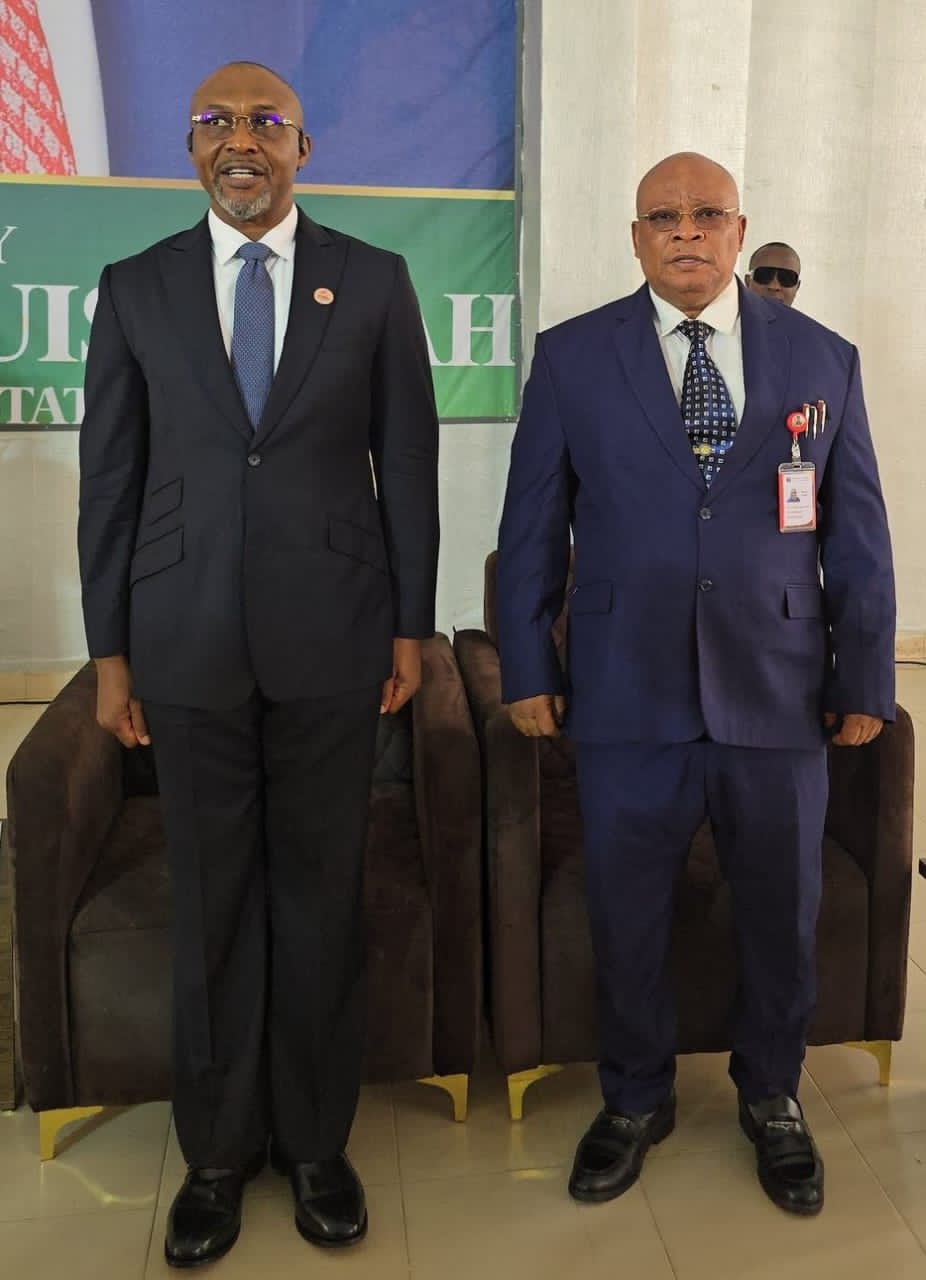
Enugu, Nigeria — The Chancellor of the Athena Centre for Policy and Leadership, Osita Chidoka, OFR, delivered the 2nd Distinguished Personality Lecture of Enugu State University of Science and Technology (ESUT) on 30 April 2026 at the Barr. Dr. Peter Ndubuisi Mbah Multipurpose Auditorium. The lecture was chaired by the Vice-Chancellor, Professor Aloysius-Michaels Okolie, and follows the inaugural edition delivered by the Executive Governor of Enugu State.
Speaking on the theme “Beyond Participation: Rebuilding Nigeria’s Political Culture for a New Generation,” Chidoka challenged what he described as a misdiagnosis of Nigeria’s democratic decline. Pointing to INEC data showing that 68 million of 93.4 million registered voters did not cast a ballot in the 2023 presidential election — a turnout of just 26.7 percent, down from 53.7 percent in 2011 — Chidoka argued that the problem is not apathy.
“Nigeria does not have an intention crisis. Nigeria has a conversion crisis. Nigerians intend to vote. But when the day comes, they begin to calculate — the cost of transport, the loss of income, the uncertainty of the process. The system makes caring expensive.”
Chidoka extended the diagnosis beyond individual behaviour to the design of Nigerian governance. Drawing on research conducted by the Athena Centre, he presented data showing that only 39 percent of Nigeria’s 36 State Houses of Assembly maintain a verified website, only 11 percent have a YouTube channel for their proceedings, and not one publishes its Hansard or Votes and Proceedings online. The Athena Legislative Transparency Index gives Nigeria’s state assemblies an average score of 18 out of 100.
He contrasted these figures with South Africa, where livestreaming of legislative proceedings is standard practice, and India, where the Right to Information Act generates over six million citizen requests annually. “When citizens cannot see how decisions are made,” Chidoka said, “accountability becomes very difficult to sustain.”
The lecture introduced what Chidoka identified as the deepest division in Nigerian governance: the contest between what he termed the Alibi Culture and the Agency Culture. He defined an Alibi Culture as one that has organised its moral energy around justifying its condition rather than changing it, converting valid historical grievances into permanent excuses. In contrast, an Agency Culture, he argued, refuses to let adversity become identity.
“The map of the world’s prosperity is the map of where excuses stopped and execution began.”
To operationalise the shift from Alibi to Agency, Chidoka introduced the philosophy of Mekaria — an Igbo word meaning “to do more, to do better” — as Africa’s answer to the question of what drives institutional improvement. Mekaria, he explained, fuses the Yoruba concept of Omoluabi (integrity), Southern Africa’s Ubuntu (humanity), and the Igbo Uchu (industry) into a single African philosophy of purposeful effort. Its operational method is the M²I framework: Measure, Monitor, Improve. “Mekaria is not a slogan,” Chidoka said. “It is a way of organising effort. It is a discipline, not an emotion.”
Citing the transformation of the Federal Road Safety Corps under measurement-driven reform as a practical example, Chidoka argued that data reduces discretion, and discretion reduced corruption. He concluded by calling on the ESUT student community to ask three questions in every institution they enter: what are we measuring; how do we know we are succeeding; and what will change if we fail.
“A country does not improve because people are angry. It improves when people begin to organise — around standards, measurement, and accountability. Not participation as an event, but participation as a habit.”
In his chairmanship remarks, Professor Aloysius-Michaels Okolie commended Chidoka’s contributions to governance and public policy, noting that the ESUT Distinguished Personality Lecture Series was designed to bridge the gap between academia and practice and to foster informed dialogue on national development. The event generated robust engagement from faculty and students, who raised questions on governance reform, legislative transparency, and the role of young Nigerians in rebuilding democratic culture.
ABOUT THE ATHENA CENTRE FOR POLICY AND LEADERSHIP
The Athena Centre for Policy and Leadership is a non-partisan policy institution dedicated to evidence-based governance, institutional reform, and public leadership development in Nigeria. Guided by the principle “We are partisan to good governance,” the Centre engages across five national priority areas: Governance and Service Delivery, Health and Human Capital, Education, Gender and GBV, and Elections and Democratic Integrity.
Media Contact
Paul Liam
Media and Communications Officer
Athena Centre for Policy and Leadership
+234 911 149 9902
info.centre@athenacentre.org