
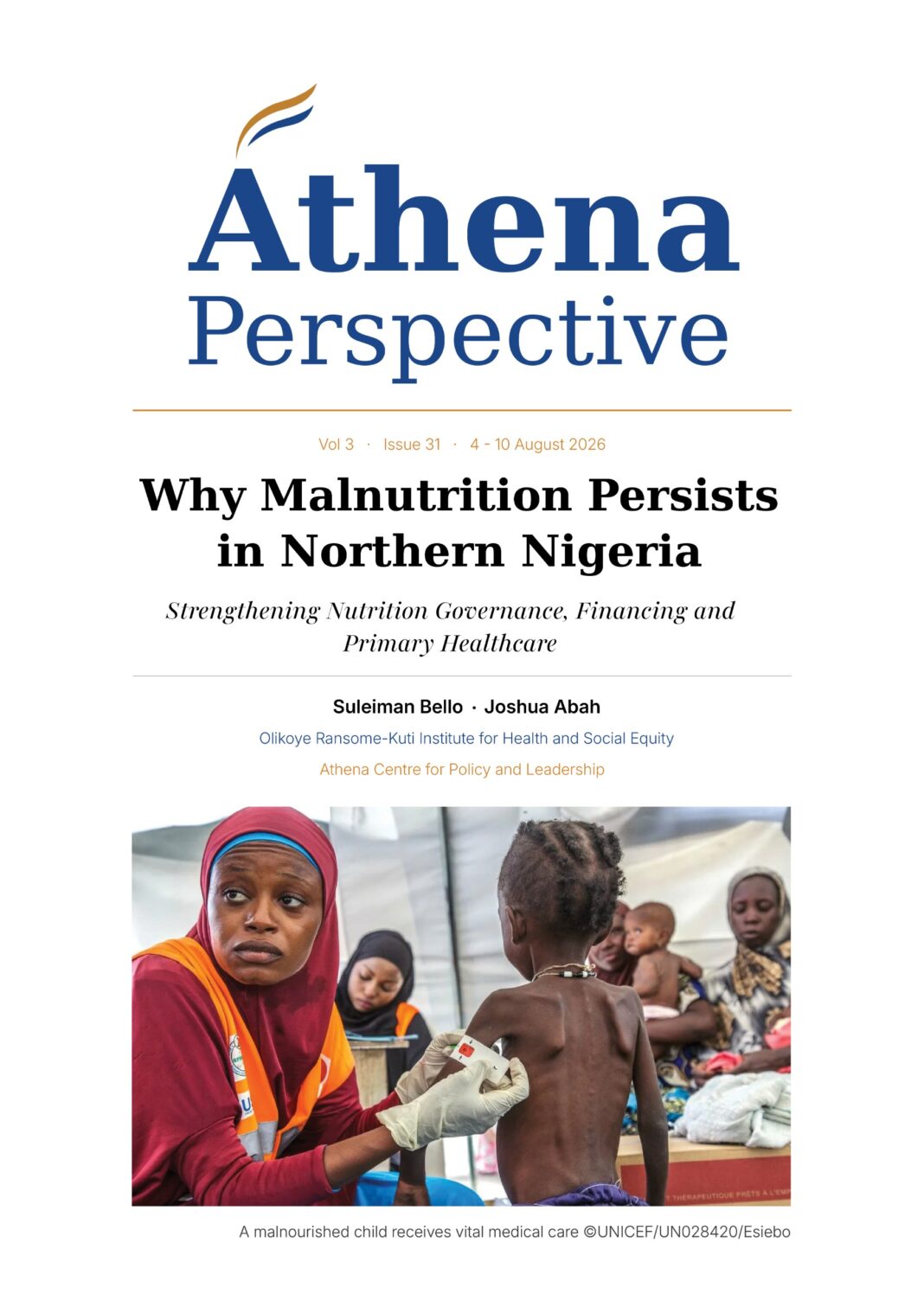

By Bashir Aliyu
A new policy report by the Athena Centre for Policy and Leadership has concluded that hunger, poverty and insecurity are being compounded by failures of governance, financing and institutional accountability, preventing nutrition policies from producing measurable
improvements in child health.
The report, Why Malnutrition Persists in Northern Nigeria: Strengthening Nutrition Governance, Financing and Primary Healthcare, finds that 40 per cent of Nigerian children under five are stunted, 8 per cent are wasted and 27 per cent are underweight.
The burden is especially severe in Northern Nigeria. In the North-West, stunting affects 46.3 per cent of children in Katsina, 43.8 per cent in Sokoto and 42.6 per cent in Zamfara. In the North-East, child food poverty affects 67 per cent of children in Borno, 66 per cent in Yobe and 60 per cent in Adamawa.
The report also cites World Food Programme data showing that more than 17 million people across nine conflict-affected northern states face crisis, emergency or catastrophic levels of hunger.
According to the authors, Dr Suleiman Bello and Joshua Abah, Nigeria has developed nutrition policies and identified effective interventions, but public institutions have struggled to convert these commitments into sustained delivery at household, ward, health-facility and state levels.
The report identifies the absence of clear institutional ownership and an accountable delivery chain linking nutrition financing, primary healthcare, social protection, agriculture and local implementation structures.
It argues that the current system remains largely reactive, responding after malnutrition has become severe or visibly apparent instead of investing sufficiently in prevention during pregnancy and the first 1,000 days of a child’s life.
Athena Centre recommends four priority reforms:
- Make verified nutrition readiness a condition for Basic Health Care Provision Fund performance financing in high-burden areas.
- Publish a quarterly nutrition compliance ledger showing budget releases, commodities procured, facilities stocked, wards reached and outstanding obligations.
- Designate a lead nutrition accountability institution in each northern state with authority to coordinate health, agriculture, water, sanitation, social protection, finance and humanitarian actors.
- Strengthen Ward Development Committees as frontline structures for identifying
vulnerable mothers and children before malnutrition becomes severe.
The report concludes that progress will depend on making nutrition a measurable obligation of government rather than a humanitarian response activated only when a crisis becomes visible.- “A child should not have to become visibly wasted before the state becomes visible,” the report
said