
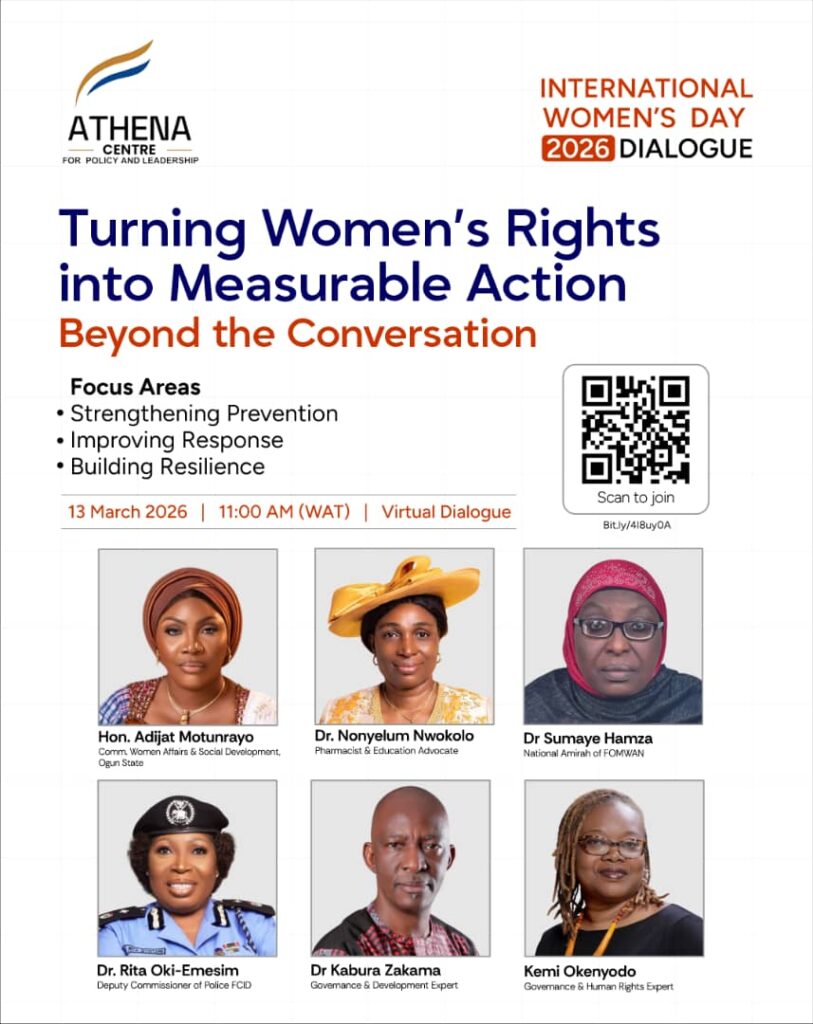
Stakeholders have backed the Athena Centre for Policy and Leadership’s Minimum Gender-Based Violence (GBV) Response Standard (MVRS) as a practical step towards strengthening institutional accountability in addressing gender-based violence in Nigeria. The framework was introduced during ACPL’s International Women’s Day webinar titled “Beyond the Conversation: Turning Women’s Rights into Measurable Action” held on March 13, 2026.
The Minimum Viable Gender-Based Violence Response Standard (MVRS) is a practical framework designed to strengthen institutional prevention systems, reporting pathways, referral coordination, documentation practices, and first-response protocols for GBV cases. It also establishes a minimum operational benchmark for community-facing institutions and service touchpoints to adopt in a phased and realistic manner. These include schools, faith communities, health facilities, community organisations, and relevant public agencies. The framework emphasizes: clear entry points for disclosure, confidentiality and do-no-harm safeguards, escalation triggers for high-risk cases, and “warm referral” procedures that enable safe handoffs to medical, legal, psychosocial, and protection services.
ACPL will publish MVRS v1.0 alongside a Pathway-to-Safety Resource Sheet and an event communiqué, and will track time-bound commitments over a 60–90-day period to support follow-through beyond International Women’s Day.
The dialogue brought together leaders from government, law enforcement, civil society, faith-based institutions, education, governance, and the justice sector to focus on what institutions can implement immediately while broader GBV systems continue to evolve.
Opening the session, Chidinma Chidoka, Executive Director of ACPL, emphasized the importance of moving from advocacy to implementation. “The MVRS sets a practical floor — the minimum steps institutions can take to improve consistency, coordination, and safety-first response, even under constrained resources,” she noted.
Panel contributions included Honourable Adijat Motunrayo (Commissioner, Women Affairs & Social Development, Ogun State), Dr. Nonyelum Elsie Nwokolo, Dr. Sumaye Hamza (FOMWAN), Kemi Okenyodo (Partners West Africa Nigeria), and Dr. Kabura Zakama. The discussion highlighted clearer institutional roles, standardized referral pathways, stronger first-response practice, and measurable accountability signals that protect privacy.
The APCL reaffirmed its commitment to advancing evidence-based policy solutions and practical governance innovations that strengthen women’s safety and rights through measurable institutional action.
Media Contact
Paul Liam, Media and Communications Officer
Athena Centre for Policy & Leadership
+234 911 149 9902 | info.centre@athenacentre.org |www.athenacentre.org