
Out-of-pocket payments made up close to 71 percent of Nigeria’s total health spending in 2023, and a government-commissioned review in Kaduna has already confirmed that beneficiaries pay for care under a policy explicitly branded “free.” The numbers, not anecdote, are the story
By Bashir Aliyu
Out-of-pocket spending accounted for 70.94 percent of Nigeria’s total health expenditure in 2023, according to figures compiled by the Commonwealth Fund from the WHO’s Global Health Expenditure Database, one of the highest shares recorded anywhere in the world and well above the 35.5 percent average for lower-middle-income countries as a group. A separate national review of healthcare financing, drawing on health-facility surveys conducted between 2010 and 2023, found that 85 percent of Nigerians who use government health facilities pay out of pocket for the care they receive there, and that 90.73 percent of respondents cited inadequate staffing and 88.47 percent cited a lack of essential medicines as major obstacles to care. Only around 5 percent of the population carries any form of health insurance or prepayment cover, according to the WHO’s Africa Health Observatory Platform profile of Nigeria’s health financing system, which means the overwhelming majority of households settle medical bills directly, at the point of need, with no pooled risk protection behind them.
The scale of the resulting financial exposure is measurable, not speculative. A national analysis using the 2018/2019 Nigeria Living Standards Survey, covering 22,110 households, found that between 34.9 and 44.2 percent of Nigerian households experienced catastrophic health expenditure, defined as health spending exceeding 15 percent of non-food consumption. An earlier national study using the 2009/2010 Harmonized Nigeria Living Standard Survey put the figure at 16.4 percent of households at a stricter 10 percent-of-total-consumption threshold, and calculated that out-of-pocket health payments alone were pushing roughly 1.3 million Nigerians below the poverty line each year. A community-based study specific to Lagos, surveying 2,492 households across four local government areas between December 2022 and March 2023, found that 15 percent of Lagos households had experienced catastrophic health expenditure, with health insurance enrolment among the surveyed households at just 1 percent. Different surveys use different thresholds and years, which is why the range is wide, but every version of the calculation lands in double digits, and none of them show the burden falling evenly.
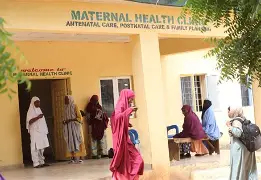
Kaduna offers the clearest documented example of the gap between a “free” policy and what actually happens at the point of care, because the state itself has now put the evidence on record. Its Free Maternal and Child Healthcare (FMCH) policy dates to 2006 and covers pregnant women and children under five. In July 2026, the Kaduna State Primary Health Care Board presented a formal review of the policy to stakeholders, including the Kaduna Maternal Health Advocacy Movement (KADMAM). The review, delivered by the Board’s Director of Community Health Services, Hajiya Nafisa Musa, listed inadequate financing, a lack of life-saving medicines, drug procurement bottlenecks, outdated policy provisions and weak management structures among its findings, and stated directly that beneficiaries still pay for some services despite the free-care policy. That is a state government’s own review, not an outside allegation: the policy exists, but its own custodians have documented that it is not functioning as advertised.
The campaign brief informing this reporting series describes a comparable pattern across the other four states, though these specific accounts come from the campaign’s own field engagement and have not been independently verified case by case. In Kano, the brief describes families being asked to buy medicines and supplies before a woman in labour can be attended to. In Lagos, it describes women seeking family planning services being turned away when commodities are out of stock, left to choose between a private pharmacy and going without. In Jigawa and Gombe, it describes rural women travelling long distances only to find that what they need is unavailable free of charge, or unavailable altogether. Read against the Kaduna review and the national catastrophic-expenditure data, these accounts describe a documented national pattern playing out at facility level, rather than an isolated failure in one state.
The connection to funding delay, examined in more detail in the companion article in this series, is direct and measurable. In Jigawa, the Jigawa Maternal Accountability Forum’s own review found that a ₦500 million family planning allocation under the Jigawa State Primary Healthcare Development Agency recorded zero expenditure through the first two quarters of 2026. In Kano, civil society group KanSLAM confirmed in April 2026 that a ₦2 billion maternal and child healthcare allocation had not been released. When a facility cannot stock oxytocin, gloves or a blood pressure cuff because the budget line meant to pay for it has not been disbursed, that shortfall is not absorbed by government. National data shows it is absorbed by the patient.
At the national policy level, the resourcing gap behind all of this is also on the public record. Nigeria’s federal health budget for 2025 stood at roughly ₦2.48 trillion, or 5.18 percent of the total national budget of ₦49.74 trillion, according to the Centre for Journalism Innovation and Development’s analysis of the appropriation. That is well under a third of the 15 percent of national budget that African Union member states, Nigeria included, committed to allocating to health under the 2001 Abuja Declaration. States that clear the 15 percent benchmark, such as Kano and Kaduna, still show large gaps between what is allocated and what reaches facilities, according to the budget performance reviews cited in this series, which indicates the shortfall is not only about the size of the allocation but about execution once a budget is signed into law.
None of the data reviewed for this article supports treating frontline health workers as the source of the problem. The Kaduna review attributes the gap to financing and supply-chain failures at the system level, not to individual staff decisions, and workers documented in accountability reports across these states are frequently the ones absorbing shortages by directing patients to nearby pharmacies rather than turning them away outright. The measurable gap, consistently, sits between a budget line and a policy document that say “free” and a disbursement and supply chain that has not been resourced to make that promise real. Kaduna’s FMCH policy, Lagos’s family planning programme and Kano’s ₦2 billion maternal health allocation already exist on paper; what the data shows missing is the funding reaching the facility before the patient does.
SOURCES AND REFERENCES
Commonwealth Fund. “Nigeria” (international health policy profile), citing WHO/Global Health Expenditure Database, 2023 figures. Updated 2026. ht
National Center for Biotechnology Information (PMC). “Critical review of healthcare financing and a survey of system quality perception among healthcare users in Nigeria (2010–2023).” https
WHO Africa Health Observatory Platform (AHOP). “Health financing – Nigeria Health System and Services Profile.”
PubMed / CNGBdb. “Catastrophic health expenditure and its determinants among Nigerian households,” using the 2018/2019 Nigeria Living Standards Survey (22,110 households). ht
PMC. “Out-of-Pocket Payments, Catastrophic Health Expenditure and Poverty Among Households in Nigeria,” using the 2009/2010 Harmonized Nigeria Living Standard Survey. https://www.ncbi.nlm.
PLOS ONE / PMC. “Factors associated with Catastrophic Healthcare Expenditure in communities of Lagos Nigeria: A Megacity experience,” 2,492-household survey, December 2022 to March 2023. https://
Voice of Nigeria. “KADMAM Seeks Implementation of Free Maternal Healthcare Policy.” July 16, 2026. https://von.
Newspanorama. “KADMAM seeks update on status of Kaduna Free Maternal, Child Healthcare Policy, advocates review.” July 17, 2026. https:
The Guardian Nigeria (Features/Health). “JiMAF Faults Slow Health Budget Implementation In Jigawa.” August 7, 2026. https://
Nigeria Info FM (Lagos). “Delayed Release of Health Funds Puts Women, Children at Risk in Kano, KanSLAM.” April 11, 2026. https://www.
Centre for Journalism Innovation and Development (CJID). “Out-of-Pocket and Out of Reach: Why Nigeria’s Health Insurance Coverage is not working,” citing the 2025 federal appropriation. June 27, 2025. https://thecjid.org/